Weybridge, Surrey: The Complete Guide to History, Things to Do & Living There (2026)
weybridge
Weybridge, Surrey: The Complete Guide to History, Things to Do & Local Life
Seventeen miles southwest of central London, where the River Wey meets the Thames, sits a town that has hosted a Tudor king’s palace, the world’s first purpose-built motor-racing circuit, and two Beatles — all within about half a square mile. Weybridge doesn’t shout about any of this. It’s the kind of place where a golf course sits on the site of an Iron Age hillfort and nobody thinks to mention it on the scorecard.
Whether you’re planning a day trip, considering a move to the area, or just curious what’s behind that name on the Waterloo train departure board, here’s everything worth knowing about Weybridge.
Where Weybridge Is and Why the Name Matters
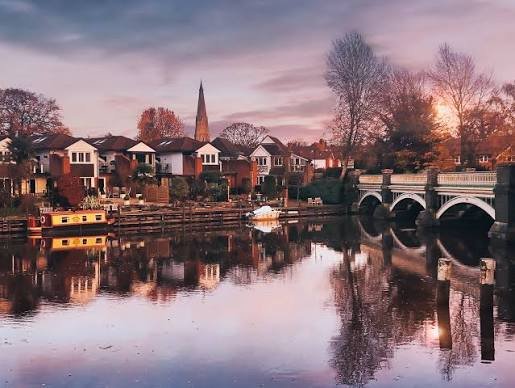
Weybridge sits in the Borough of Elmbridge in Surrey, bordered by Shepperton to the north, Walton-on-Thames to the east, Wisley to the south, and Addlestone to the west. The name is about as literal as English place names get — it means “bridge over the River Wey,” and there’s been a crossing here in some form since at least the 7th century, when the settlement first appears in written records as Waigebrugge.
The town centre clusters around the point where the Wey meets the Thames, but Weybridge’s boundaries stretch further than most visitors realise, taking in both St George’s Hill to the south and the former Brooklands racing circuit.
A Town With an Unusually Big History
Henry VIII’s Lost Palace
In 1537, Henry VIII began building Oatlands Palace on the site of an existing manor house north of the town centre, intending it as a home for his fourth wife, Anne of Cleves. That marriage was annulled within six months, but the king went on to marry his fifth wife, Catherine Howard, at Oatlands that same year. The palace stayed a royal residence until the English Civil War, when it was sold off and demolished in the early 1650s. Little survives today beyond a side gateway, though Oatlands Park Hotel now occupies a later mansion built nearby on the same estate.
The Birthplace of British Motorsport
Weybridge’s biggest claim to fame arrived in 1907, when Brooklands opened as the world’s first purpose-built motor-racing circuit. It hosted the first two British Grands Prix in the 1920s, and Malcolm Campbell developed his final land-speed-record car there. The site was equally important to British aviation — aircraft built or tested at Brooklands over the decades included the Sopwith Camel, the Wellington bomber, and, later, components for Concorde. Aircraft manufacturing at the site continued until 1988. Today, Brooklands Museum occupies part of the original circuit and displays historic racing cars, aircraft, and a full-size Concorde.
The St George’s Hill Years
In the 1910s, developer W. G. Tarrant built one of the country’s most exclusive estates on St George’s Hill, requiring every plot to be at least an acre. It’s since become one of the most quietly famous addresses in British pop culture: John Lennon lived there from 1964 to 1968, and Ringo Starr was his neighbour over the same period. Cliff Richard also had his main home in Weybridge for a stretch. It’s the sort of detail that rarely makes it into standard travel guides, but it’s real, well-documented local history.
A Town That Inspired Fiction
Weybridge has left its mark on literature too. H. G. Wells devoted an entire chapter of The War of the Worlds to the town, describing a Martian fighting machine collapsing into the Thames near Weybridge. Novelist E. M. Forster lived at Monument Green in the early 1900s and wrote all six of his novels during that period. French novelist Émile Zola even spent part of his exile from France staying at Oatlands Park Hotel in the late 1890s.
Things to Do in Weybridge
Brooklands Museum — The obvious starting point for any visit. Beyond the racing and aviation history, you can walk a surviving stretch of the original banked circuit and see the Concorde up close.
Mercedes-Benz World — Built on part of the old Brooklands site, this free-entry attraction offers driving experiences and simulators alongside a collection of historic road and racing cars.
Thames Path and the Wey Navigation — Weybridge sits at the confluence of two rivers, and the towpaths make for some of the most pleasant walking in this part of Surrey, particularly around Desborough Island.
St George’s Hill — Beyond its musical history, the area offers a genuinely good vantage point over the surrounding Surrey countryside, and makes for a rewarding walk if you don’t mind a bit of a climb.
Elmbridge Museum — A small but well-curated collection covering local history, including artefacts recovered from Oatlands Palace.
Painshill Park and Wisley Gardens — Both a short drive away, and easily combined with a day in Weybridge itself for anyone spending a full day in the area.
Weybridge’s annual events — The Brooklands Festival of Motorsport and the Weybridge Community Regatta on the Desborough Cut are the two fixtures worth planning a trip around, alongside the town’s regular farmers’ markets.
Living in Weybridge
Weybridge has long been one of the more sought-after commuter towns southwest of London, and the numbers back that up — in 2008, six of the ten most expensive streets in the UK outside Greater London were located here, most of them on St George’s Hill.
The appeal is straightforward: a direct rail line into London Waterloo via Clapham Junction, a genuinely green setting between two rivers, and a housing stock that ranges from Victorian terraces near the town centre to the large detached properties that dominate St George’s Hill. The area is served by several well-regarded primary schools and by Heathside School and St George’s College for secondary education, with Brooklands College offering further and higher education options locally.
For anyone weighing up Weybridge against neighbouring towns, the general pattern holds: Walton-on-Thames tends to be slightly more affordable with a livelier high street, while Weybridge trades on space, greenery, and prestige, particularly around St George’s Hill.
Getting There
Weybridge railway station, opened in 1838, sits south of the town centre and is served by South Western Railway, with direct trains to London Waterloo and to Woking. The town is also on National Cycle Route 4, and local bus services connect Weybridge to the surrounding towns in northwest Surrey.
The Bottom Line
Weybridge rewards a closer look. It’s easy to file it away as just another affluent Surrey commuter town, but few places this size can claim a Tudor palace, the birthplace of British motor racing, a Beatle’s former home, and a starring role in one of the most famous science-fiction novels ever written. Whether you’re visiting for an afternoon or considering it as a place to live, there’s considerably more going on here than the view from the train window suggests.
Internal linking suggestions: link “Brooklands Museum” to a dedicated Brooklands Museum guide post, “St George’s Hill” to a St George’s Hill / celebrity history post, “living in Weybridge” section to a Weybridge property market post, and “annual events” to your events calendar pillar page.
About The Author