Caricatronchi: A New Way to Think About Digital Caricature
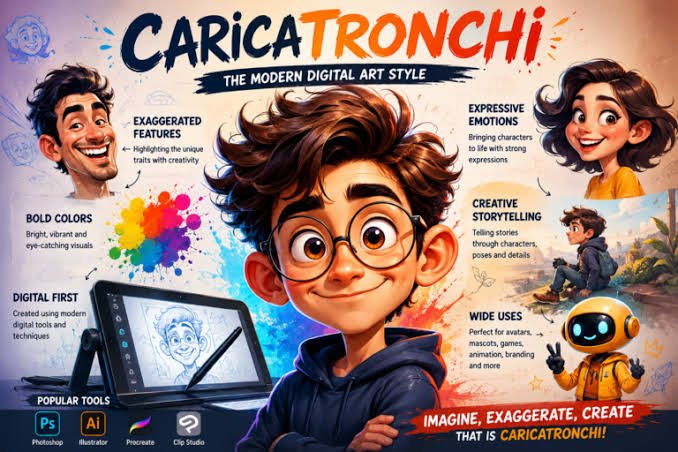
caricatronchi
Quick honesty check before we dive in: caricatronchi isn’t some ancient art tradition with a long documented history. It’s a newer, still-forming concept, and I think that’s actually the interesting part. You’re catching it early, basically.
I stumbled into thinking about this after messing around with a few digital caricature tools and getting frustrated by something specific. Every app, every filter, every “cartoonify yourself” tool does the same thing. Big head, exaggerated eyes, done. The face gets all the attention. The rest of the body? Ignored. Just shrunk down and left alone, like an afterthought.
That bugged me, honestly. So caricatronchi, as I’d define it, is about fixing that gap.
What Caricatronchi Actually Means
Break the word apart and you get two pieces. Carica — Italian for “load” or “exaggerate,” the same root classic caricature comes from. And tronchi — Italian for trunks, or fragmented forms, or torsos, depending on how loosely you translate it.
Put together, caricatronchi is caricature that doesn’t stop at the neck.
Instead of just blowing up someone’s nose or grin, this style exaggerates posture, body shape, gesture, the whole physical presence of a person or character — while still keeping that classic caricature humor and warmth. A hunched shoulder gets more hunched. A confident stance gets almost cartoonishly confident. The torso itself becomes part of the joke, part of the personality, not just filler space under a big head.
Why the Face-Only Approach Was Always Kind of Limiting
Think about it for a second. So much of how we read a person comes from their body language, not just their face. The way someone slouches when they’re tired. The way someone squares their shoulders when they’re proud. That stuff is expressive too, arguably more honest than a facial expression sometimes, since faces are easier to fake than posture.
Classic caricature figured this out ages ago in a small way — bigger heads, tiny bodies, that visual joke has been around forever. But it rarely went further than that. The body stayed passive. Just a base for the head to sit on.
Caricatronchi flips the ratio of attention. The body gets treated with the same exaggeration-for-personality logic that the face always got. That’s really the whole pitch.
What This Could Look Like in Practice
I picture a few directions this style could go, honestly, and none of them require fancy tools — just a shift in thinking.
Gesture-first sketches. Instead of starting with the face like most caricature tutorials tell you to, start with the pose. What’s the body doing? Is it leaning in, curled up defensively, sprawled out lazy? Nail that first, exaggerate it hard, then build the (still exaggerated) face on top.
Fragmented, stylized torsos. Rather than a smooth, proportional body, break it into chunky, almost geometric segments — a nod to the “tronchi” (fragments/trunks) idea. It gives characters a slightly sculptural, blocky charm instead of the usual soft cartoon roundness everyone defaults to.
Personality-driven proportions. A shy character might get a smaller, more folded-in body shape. A boisterous one might get a chest-out, oversized stance. The exaggeration isn’t random — it’s mapped to who the person or character actually is.
Who Would Actually Use Something Like This
I think it fits creators who feel like standard caricature avatars and profile pics have gotten a little samey. Every tool spits out roughly the same big-head-small-body template now. There’s room for something that reads as more distinctive.
Illustrators looking for a fresh personal style could lean into it. Brands wanting mascot characters with more physical personality, not just a funny face, might find it useful too. And honestly, anyone who’s ever looked at a standard caricature of themselves and thought “eh, it’s fine, but it doesn’t really feel like me” — that’s the itch this scratches. Because a lot of what makes someone recognizable isn’t just their nose. It’s how they carry themselves.
A Few Honest Limitations
I won’t pretend this is a fully mapped-out discipline with rules and masters and a hundred years of tradition behind it. It’s not. It’s an idea, still rough around the edges, and reasonable people could define caricatronchi differently than I just did.
There’s also a real technical challenge here — exaggerating a whole body convincingly is genuinely harder than exaggerating a face. Faces have well-understood proportions people intuitively judge as “off” or “right.” Bodies in motion or unusual poses are trickier. Get it wrong and it just looks broken instead of expressive.
Where I Think This Goes
If digital art keeps trending toward more personality-driven avatars — and it clearly is, with how much people care about self-expression online — I think concepts like caricatronchi have room to grow. Not as a replacement for classic caricature. More as an extension of it. Taking that same instinct — exaggerate what makes someone them — and applying it to the whole figure instead of just the face.
Worth experimenting with, if you’re a digital artist looking for something a little different to play around with. I know I am.
About The Author