EasyJet Flight U2238 Emergency Landing Newcastle: What Actually Happened
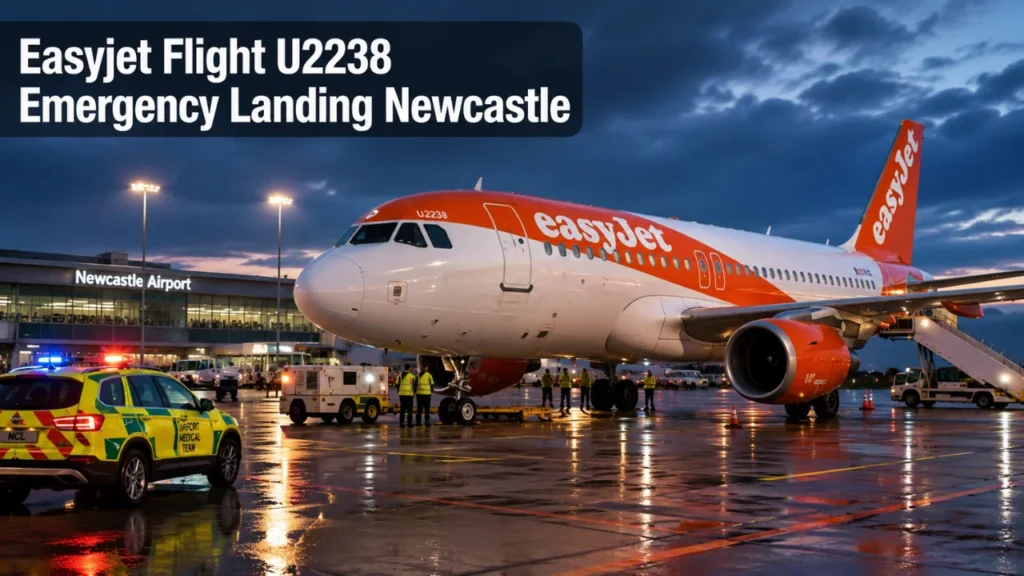
easyjet flight u2238 emergency landing newcastle
EasyJet Flight U2238 Emergency Landing Newcastle: What Actually Happened
If you’ve searched “easyJet flight U2238 emergency landing Newcastle,” you’ve probably noticed something odd already. A lot of the results don’t quite agree with each other. Some throw around the number U2238. Others say U22238. A few mention EZY2238. Confusing, right? I went digging, and honestly, the mix-up itself is kind of the story here.
Let’s sort it out properly.
The Flight Number Confusion, First
Here’s the thing nobody tells you upfront: U2238 is a real, completely ordinary easyJet flight. It runs between Newcastle and Bristol. Short domestic hop. Nothing dramatic about it, ever. On the date most articles reference, that particular flight operated as normal.
The flight everyone’s actually talking about was EZY2238, also listed in some records as U22238. Same digits, one extra character, wildly different story. It’s an easy typo to make, and once one website made it, dozens of others copied the mistake. That’s just how online news spreads sometimes — fast, and not always carefully.
So. Keep that straight in your head as we go.
What Actually Happened
On the evening of 27 October 2025, an Airbus A320 — registration G-EZPB — took off from Copenhagen, Denmark, heading to Manchester. It left slightly behind schedule, around 10:13 PM local time. <cite index=”7-1″>The flight was carrying 178 passengers.</cite>
Not long into the flight, things changed.
<cite index=”16-1″>Less than 15 minutes after takeoff, a passenger became seriously unwell.</cite> Cabin crew noticed and acted quickly, alerting the flight deck. From there, the pilots made a call that probably felt obvious in the moment but was still a big decision: divert.
<cite index=”7-1″>The crew activated squawk 7700 — the international transponder code that tells air traffic control “this is an emergency, treat us as priority.”</cite> That code doesn’t necessarily mean the plane itself is in danger. It just means something needs urgent attention, and everyone downstream needs to know fast.
Instead of continuing over the North Sea toward Manchester, the pilots turned toward Newcastle International Airport — <cite index=”10-1″>the nearest suitable runway with medical support standing by.</cite>
Why Newcastle, Specifically?
Good question, and one a lot of people ask. It comes down to geography and timing, mostly.
<cite index=”11-1″>The captain makes the final call after weighing the passenger’s condition, the aircraft’s position, weather, nearby airports, and what medical support is actually available on the ground.</cite> Newcastle happened to be the closest, most capable option at that point in the flight. Simple as that, really. No drama, no politics — just proximity.
Did the Plane Actually Land Safely?
Yes. No question about it.
The aircraft touched down <cite index=”9-1″>shortly before 11:00 p.m. local time</cite>, and it landed exactly the way you’d want it to — under full control, no drama on the runway. Paramedics were already waiting when the wheels hit tarmac.
I think this bit gets lost in a lot of the coverage, honestly. “Emergency landing” sounds terrifying if you’re not familiar with aviation terms. But in this case, the emergency was entirely about the passenger’s health, not the aircraft’s condition. <cite index=”11-1″>No reliable report identified any mechanical fault, fire, or damage to the plane itself.</cite>
That distinction matters. A lot.
What Happened to the Unwell Passenger?
Once on the ground, medical teams boarded quickly and took over care of the affected passenger. <cite index=”11-1″>Details about their identity, diagnosis, and eventual condition have remained private</cite> — which, frankly, is exactly how it should be. Nobody’s medical emergency needs to become internet content.
Did the Flight Continue?
It did. <cite index=”9-1″>After the passenger received the care they needed, the aircraft was refuelled and continued on to Manchester.</cite> Remaining passengers arrived at their destination later than planned, obviously, but they got there.
<cite index=”8-1″>The diversion meant an extra stop for people heading to Manchester, sure, but it also meant the unwell passenger got professional care as fast as humanly possible.</cite> Worth the delay, most would agree.
What Did EasyJet Say?
<cite index=”14-1″>EasyJet confirmed the diversion, stating that flight EZY2238 from Copenhagen to Manchester diverted to Newcastle “due to an urgent medical condition with a customer on board,” and that the airline’s priority is always the safety and wellbeing of everyone on the aircraft.</cite>
Standard airline language, sure. But also — accurate, in this case.
Were Other Passengers Hurt?
No. <cite index=”9-1″>There were no reports of injuries to other passengers or crew members throughout the incident.</cite> Just one person needing urgent care, and a well-drilled crew responding exactly as trained.
Why This Story Spread So Fast
Partly the flight-number mix-up, like we covered. But partly, I think, it’s just how these things go now. A squawk code gets picked up on a flight-tracking app, someone screenshots it, it hits social media within minutes, and suddenly a routine (if stressful) medical diversion looks like a full-blown crisis online.
In my experience following this kind of aviation news, that pattern repeats constantly. The plane’s fine. The procedure worked. But the headline writes itself as “EMERGENCY” because, well, that’s what gets clicks.
The Bigger Takeaway
Emergency landings like this one aren’t actually rare, and that’s sort of reassuring if you think about it. Airlines train extensively for exactly this scenario — a passenger falling ill mid-air, a quick diversion, a safe landing, medical help on standby. It’s a system built to work under pressure, and on 27 October 2025, it did exactly that.
So next time you see a headline screaming “EMERGENCY LANDING,” maybe pause before panicking. Sometimes it really is just a plane doing what it’s supposed to do — taking care of the person who needs it most, then carrying on.
About The Author