Connections Hint Guide: How to Solve the Daily Word Puzzle Without Losing Your Mind
connections hint
It’s 7 a.m. I’ve got coffee in one hand and my phone in the other, squinting at sixteen words that apparently belong in four neat little groups. They don’t look neat. They look like chaos. This is the daily ritual for millions of people now, and if you’re reading this, you’ve probably typed “connections hint” into Google more than once in a moment of mild desperation. No shame in that. We’ve all been there.
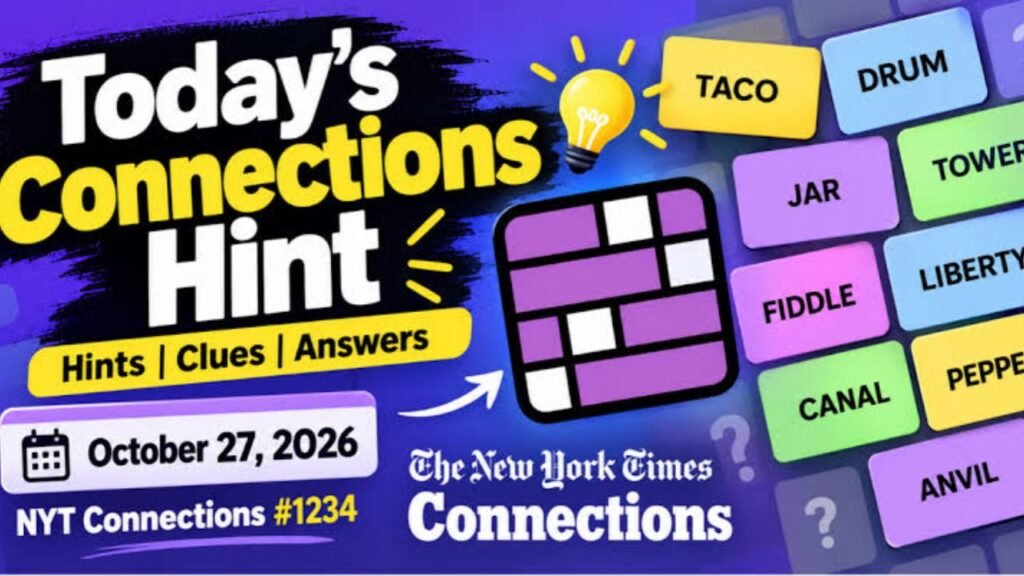
Connections, the New York Times word puzzle, is deceptively simple and genuinely maddening. You get sixteen words. You sort them into four groups of four based on a shared theme. Sounds easy. It almost never is, because the puzzle’s whole personality is built on tricking you.
What Connections Actually Is
Quick refresher, in case you wandered in cold. Connections shows up every day with a fresh 4×4 grid of words or short phrases. Your job: find the four groups of four that share something in common, then submit each group once you’re confident.
Each group has a color, and the colors are a hint in themselves — yellow is usually the easiest, purple is usually the “wait, what?” category that makes you question your vocabulary. Green and blue sit somewhere in the middle, often overlapping in sneaky ways.
Here’s the catch, though. The puzzle designers want you to see fake patterns. A word that seems to obviously belong with three others might actually belong in a totally different group. That’s the whole game. It’s not testing your knowledge so much as testing your patience.
Why Hints Are Basically a Lifeline
I’ll admit something. I once lost a four-game streak because I was absolutely sure “SEAL,” “LION,” “TIGER,” and “BEAR” belonged together as animals. Nope. One of them was part of a “types of balm” category, and another snuck into something about sports mascots. My streak? Gone. My pride? Also gone.
That’s why a well-timed hint matters so much. In my experience, a good connections hint doesn’t hand you the answer on a silver platter — it just nudges you toward the right way of thinking. Maybe it points out that one word has a double meaning. Maybe it tells you which category is the trickiest one today. Small nudge, big difference.
There’s also something oddly comforting about hints. They remind you that the puzzle is designed to be hard, not that you’re bad at words. A little reassurance goes a long way at 7 a.m.
How a Connections Hint Usually Works
Most hints follow a pattern, whether they come from a friend, a hint website, or your own gut after staring long enough. They tend to fall into a few buckets:
- Category hints — a general idea of what one group is about, without naming the words. Like “one category is types of knots.”
- Word hints — pointing out that a specific word has a sneaky double meaning. “BAT” could be an animal or sports equipment, for example.
- Difficulty hints — telling you which color (purple, usually) is hiding the weirdest connection today.
- Overlap hints — warning you that two categories look almost identical on the surface. This one trips up everybody, even seasoned players.
The overlap thing deserves its own paragraph, honestly. Connections loves to put four words that are technically related into two different buckets. You’ll see four fruit names and assume they’re one group — except one of them is secretly part of a category about slang for money. Rude. But that’s the fun of it, I guess.
Using Hints Without Ruining the Fun
Here’s the thing nobody tells you: using a hint doesn’t make you a cheater. It makes you a person with a job and limited patience. Still, there’s a way to use hints that keeps the puzzle enjoyable instead of just handing you the answer key.
- Start with the easy group. Usually yellow. Lock that one in first, it builds momentum and narrows your remaining words.
- Look for words with multiple meanings. If a word feels like it could fit two categories, it probably does. That’s intentional.
- Use one small hint at a time. Don’t jump straight to the full solution. Read a category hint, think for thirty seconds, then decide.
- Trust your “too obvious” instinct. If four words seem perfectly grouped right away, be suspicious. The puzzle is baiting you, almost always.
- Take a break if you’re stuck. I know, easier said than done. But walking away for five minutes genuinely helps you see the words fresh.
I use hints maybe once a week, when I’m genuinely stuck and running late for work. The rest of the time I just sit with the chaos until it clicks. There’s a weirdly satisfying “aha” moment when it finally does.
Mistakes Almost Everyone Makes
First mistake: guessing too fast. You see four words that look right together and you just hit submit. Big mistake. Huge. The puzzle rewards patience, not speed, even though the little streak counter makes you feel like speed matters.
Second mistake: ignoring the “one away” message. When the game tells you that you’re one word off, that’s basically a free hint. Swap out the word that feels weakest and try again instead of guessing blind.
Third mistake, and this one gets me every time: assuming the category title matches the obvious theme. Purple categories especially love wordplay, puns, or categories based on sound rather than meaning. “Sounds like” categories are brutal if you’re not expecting them.
And honestly? Overthinking the easy stuff is a mistake too. Sometimes yellow really is just yellow. Not everything has a twist.
Final Thought
At the end of the day, a connections hint is just a tool. Use it, don’t use it, there’s no wrong way to play. I think the real joy of the game is that it’s quick, a little silly, and oddly bonding — my family group chat turns into chaos every morning arguing over purple categories.
So grab your coffee, take a breath, and give it a shot before you peek at any hint. You might surprise yourself. And if not? Well, there’s always tomorrow’s puzzle.
About The Author