The Strange Truth About “Acamento” — A Word That Admits It’s Probably a Typo
acamento
The Strange Truth About “Acamento” — A Word That Admits It’s Probably a Typo
Okay, so I went back and dug deeper into this one. And honestly? What I found is stranger, and a bit funnier, than I expected.
Let me explain.
Quick Recap: What Is Acamento Supposed to Mean?
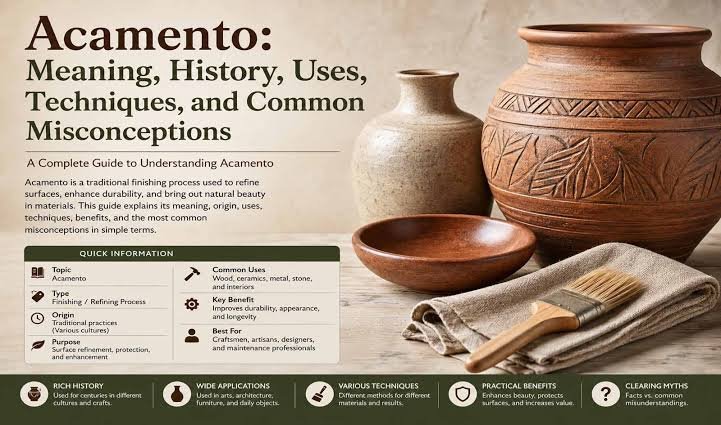
If you’ve landed on any of the dozens of near-identical articles floating around, they’ll tell you acamento means the finishing touch, the final polish that turns a raw product into a complete one. Sanding a table. Painting a wall. That kind of thing.
They’ll also tell you it comes from the Portuguese word acabamento, meaning “finishing” or “completion.” That part’s true, by the way. Acabamento is a genuine, dictionary-verified Portuguese word.
Acamento, without the “ab,” is where things get interesting.
Here’s the Actual Smoking Gun
I went looking for whatever site seems to be the original source behind this whole trend, and found something genuinely telling. The site branding itself as the home of the word, run by someone identifying as a “content analyst” whose stated job is spotting “fake online trends,” includes this line in its own About page, more or less: even though “acamento” might just be a typo or a playful twist on the real word, it’s still a fun way to talk about making things better.
Read that again. The source most responsible for popularising this word openly admits, in its own content, that it’s probably just a typo.
I think that’s genuinely one of the more honest bits of self-awareness I’ve seen in this corner of the internet, even if it’s buried halfway down a page written, by its own description, so a ten-year-old could understand it.
Why This Matters More Than You’d Think
Here’s the thing that actually bugs me a bit, honestly. Once I started looking at where these “acamento” articles were actually published, a pattern emerged fast. Loads of them sit on general-purpose content sites that publish this exact same style of article, about a whole rotating cast of similarly obscure, similarly unverifiable made-up terms.
Same formula every time. “What Is [Word]? Meaning, Uses, and Everything You Need to Know.” Same vague sourcing. Same claim of a foreign-language origin. Same soft admission, buried somewhere in the piece, that the details aren’t fully confirmed.
It’s not really about acamento specifically at that point. It’s a content template, repeated at scale, across dozens of invented or borderline-invented terms, built to catch curious searchers exactly like you, someone who saw a strange word and wanted an honest answer.
So Is It a Real Word or Not?
Best honest answer I can give: no, not in any dictionary-verified sense. It looks like a variant spelling, likely originating from a typo of “acabamento,” that got noticed, picked up, and deliberately built into a content trend once someone spotted the search traffic potential.
Is that inherently dishonest or dangerous? Not really, no. Nobody’s being scammed out of money here. It’s just… a word that doesn’t quite exist yet, being written about as though it definitely does, by people who, in at least one case I found, half-admit that themselves.
What You Should Actually Take From This
I think there’s a genuinely useful lesson buried in this whole rabbit hole, honestly, beyond just this one word.
When you see a “trending term” article, especially one using that exact structure, meaning, origins, uses, modern applications, FAQ section at the bottom, it’s worth pausing and asking: where does this term actually show up outside of these articles? Does a real dictionary list it? Does it appear in genuine, non-blog writing anywhere? If the answer’s no across the board, that’s a meaningful signal, not proof of anything malicious, just a reason to hold the definition loosely.
What You Should Actually Call This Concept
If you’re after the real word for what “acamento” is gesturing at, finishing touches, final polish, completion, here’s what I’d actually use:
- Acabamento, if you’re specifically working in a Portuguese-language context and want the real, dictionary-backed term.
- “Finishing” or “finishing touches”, in plain English, for construction, design, furniture, fashion, basically anything physical.
- “Polish” or “refinement”, if you’re talking about writing, design work, or anything more abstract.
All three of those actually exist in real dictionaries. That’s worth something.
Final Thoughts
The “acamento” story turned out to be a genuinely interesting little case study, honestly, not because the word itself matters much, but because it’s a clean example of how a probable typo can get dressed up, repeated, and cross-published until it starts looking legitimate purely through sheer volume.
Even the site most responsible for the trend seems to half-know this, tucked into its own About page. I think that’s worth remembering next time a “trending word” article shows up in your search results with suspiciously confident vibes and suspiciously little actual sourcing behind it. Ask where it actually comes from. Sometimes, as it turns out, the honest answer is sitting right there in the fine print.
Useful links:
- Priberam Portuguese Dictionary — “acabamento”
- Infopédia Portuguese-English Dictionary
- Linguee — “acabamento” in context
About The Author