iPhone Duo: Apple’s First Foldable, Explained Simply
iphone duo
iPhone Duo: Apple’s First Foldable, Explained Simply
Okay, so it actually happened. After years of leaks, patent filings, and “any day now” rumors that never quite panned out, Apple finally made a folding iPhone. Feels a bit surreal typing that sentence, honestly, after so many false starts.
Let’s get into what it actually is.
Wait, Apple Made a Foldable? For Real?
Yep. The iPhone Duo is a genuine foldable smartphone from Apple, the first iPhone ever built with a folding design. Which is a big deal, honestly, given how long Samsung and others have had the foldable space largely to themselves.
Apple’s been sitting on this idea for way longer than most people realize, too. Development apparently started back in 2011, with production reportedly kicking off in June 2026. That’s a fifteen-year gestation period for one product. I think that says something about how cautious Apple tends to be before actually shipping something new, rather than just rushing to compete.
It was officially announced on September 9, 2026, alongside the iPhone 18 Pro and Pro Max lineup.
What Does It Actually Look Like?
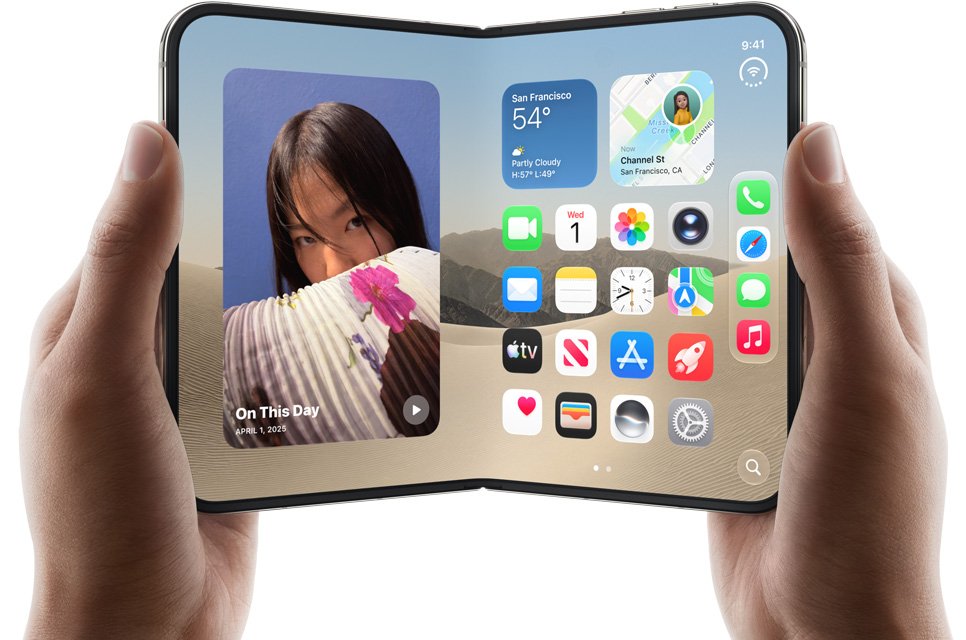
Here’s the fun bit. Closed, it works like a totally normal iPhone. Opened, it reveals a much bigger inner display, similar in spirit to a small tablet.
The numbers are genuinely impressive, honestly. The inner display comes in at 7.6 inches, with a 5.4-inch outer screen, and both support ProMotion, Always-On functionality, and up to 3,000 nits of outdoor brightness. For comparison, that inner screen is noticeably bigger than a standard iPhone, closer to iPad Mini territory when unfolded.
One detail I actually appreciate: there’s a nano-texture finish on the inner display specifically designed to reduce reflections and make the fold crease less noticeable. Crease visibility has been the single biggest complaint about foldables for years, so it’s good to see Apple clearly trying to address it head-on rather than ignoring the issue.
Built Like a Tank, Apparently
Durability’s always the elephant in the room with foldables, right? Fold something enough times and eventually something’s going to give.
Apple’s gone with a titanium build, Ceramic Shield protection, and an IP68 rating for water and dust resistance. The hinge itself is described as precision-engineered, offering a smooth, satisfying feel with repeated use. Under the hood, that hinge apparently uses more than 100 individual components just to make the folding motion feel right.
That’s a lot of tiny moving parts, honestly. I think that level of mechanical complexity is exactly why Apple took so long getting here. Better to arrive late with something that actually holds up than rush out something that creaks after six months.
What’s Powering It?
The iPhone Duo runs on Apple’s new A20 Pro chip, built on a 2-nanometer manufacturing process, paired with a vapor-chamber cooling system. That cooling setup, combined with a dual-battery architecture, is meant to deliver properly strong all-day battery life alongside genuine pro-level performance.
On the camera side, it’s rocking 48MP Fusion Main and 48MP Fusion Ultra Wide cameras, capable of 4K video at 120fps in Dolby Vision, plus foldable-specific features like Duo Preview, Smart Take, and Dual Capture. Some genuinely fold-specific camera tricks there, not just a standard iPhone camera bolted onto new hardware.
Colors and Storage
Keeping it simple on the color front, at least. It’s available in two finishes, star white and night sky, crafted from grade 5 titanium polished to a mirror finish.
Storage options range from 256GB right up to 2TB, and connectivity is eSIM-only worldwide. Worth noting if you’re still relying on a physical SIM card, this one’s going fully digital.
Right, Let’s Talk Price
Deep breath. The iPhone Duo starts at $1,999 in the US, working out to roughly $83.29 per month over 24 months if you finance it. That’s $700 more than the iPhone 18 Pro Max, creating a genuinely new premium tier above Apple’s existing top-end phones.
Pricing shifts a fair bit by region too. In the UK it ranges from around €2,369 up to €3,869, while in the UAE it starts at AED 8,499, Australia starts at A$3,499, and Canada comes in at $2,999 CAD. In India, the entry 256GB model starts at ₹2,99,900, with the 512GB, 1TB, and 2TB variants stepping up from there.
I think that price tag is genuinely the biggest hurdle here, honestly. Two grand is a serious ask, even by iPhone Pro Max standards, and it’s fair to expect Apple’s marketing team to work hard justifying that gap.
When Can You Actually Get One?
Pre-orders open October 16 at 5 a.m. Pacific Time, with the device officially launching October 23 across the US and more than 70 other countries and regions, including Australia, Canada, China, France, Germany, and India.
Not a huge wait from announcement to shelf, honestly, which is fairly typical for Apple’s launch cadence these days.
Is It Actually Worth Buying?
Honestly? Depends entirely on what you actually do with your phone day to day.
If you’re someone who’s constantly juggling apps, editing on the go, or just wants the biggest possible screen without carrying a tablet separately, the Duo’s inner display genuinely sounds like it could change how you use a phone. That’s not nothing.
But if your phone use is mostly texting, scrolling, and the occasional photo? I think it’s genuinely hard to justify $700 extra over an already excellent iPhone 18 Pro Max just for a fold you might not use as often as you’d expect going in. Foldables are still a genuine lifestyle shift, not just a spec bump.
My honest take, for what it’s worth: wait for real-world reviews on hinge durability and crease visibility before jumping in on launch day. First-generation Apple products have a habit of getting meaningfully better by version two.
Final Thoughts
The iPhone Duo is a genuinely significant moment, Apple’s first real foray into foldables, after over a decade quietly working on the idea behind the scenes. The specs are properly impressive, and the durability focus feels considered rather than rushed.
Whether it’s actually worth the money, though, honestly comes down to you. Big screen real estate and pro-level performance, sure, but at a genuinely premium price for a genuinely new, still-unproven-long-term form factor.
Useful links:
- Apple Newsroom: iPhone Duo Announcement
- Apple: iPhone Duo Product Page
- MacRumors: iPhone Duo Release Date and Pre-Orders
About The Author