What Is a Messeregge? The Knife Harrow Farmers Use Before Planting
messeregge
What Is a Messeregge? The Knife Harrow Farmers Use Before Planting
Ever seen a farmer drag a strange, blade-covered frame across a field right before planting season and wondered what on earth it was doing? There’s a decent chance it was a messeregge.
It’s not a household word. Most people outside farming circles have never heard it. But if you spend time around German or Central European agriculture — or you’re a student digging into soil prep equipment — the term comes up more than you’d expect.
Let’s break it down properly.
The Word Itself Tells You What It Does
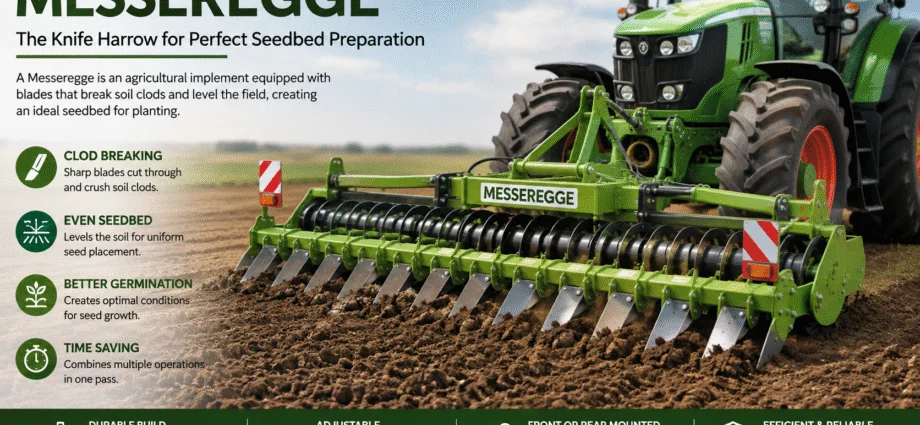
Messeregge is a German compound word. Split it in two and you get Messer (knife or blade) and Egge (harrow). Put them together, and the literal translation is “knife harrow.” Simple as that.
And honestly, German is great for this kind of thing — the name isn’t marketing fluff, it’s a direct description of the tool. No guessing required.
So What Does a Messeregge Actually Do?
A messeregge is a lightweight farming implement designed to work the very top layer of soil — usually just 1 to 5 centimeters deep. It’s fitted with angled, blade-like cutting elements instead of the flexible tines you’d find on a standard harrow.
Picture this scenario. It’s early spring. The field has already had its main tillage pass. But a heavy April rain came through, and now there’s a hard crust on top, some clumped crop residue, and ruts left behind from tractor wheels. The seed drill is ready to go, but if the soil surface isn’t right, seed-to-soil contact suffers. And that’s not a small problem — poor emergence can cost a noticeable chunk of the crop before it even has a chance to grow.
This is exactly where a messeregge earns its keep. It slices through the crust, cuts up surface residue, and levels things out — all without digging deep or disturbing the soil structure underneath.
Messeregge vs. Standard Disc Harrow — What’s the Difference?
This is where a lot of confusion happens, so let’s clear it up.
A disc harrow is a heavier tool. It churns soil, inverts layers, and works much deeper into the ground. That’s useful for breaking up tough ground or incorporating heavy residue after harvest. But it also disturbs a lot of what’s happening beneath the surface — moisture retention, microbial activity, soil structure. All of that gets shaken up.
A messeregge, on the other hand, stays shallow on purpose. It’s a finishing tool, not a primary tillage tool. Think of it less like plowing and more like smoothing icing on a cake — you’re refining the surface, not rebuilding the whole thing.
That distinction matters a lot to farmers who care about soil health. Minimum-tillage and conservation-tillage systems, in particular, favor implements like this because they get the seedbed ready without wrecking the deeper soil profile.
Why Farmers Actually Choose This Tool
A few practical reasons keep coming up:
- Speed. Because it’s shallow and light, a messeregge can cover ground fast — useful when there’s a tight planting window after rain.
- Reduced soil disturbance. Farmers focused on preserving moisture and soil biology tend to prefer it over deeper tillage.
- Residue management. It cuts through crop residue rather than dragging it into clumps, which helps avoid clogging during planting.
- Better seedbed uniformity. A smoother, more level surface generally means more consistent emergence — and that’s the whole point of the exercise.
None of this makes it a replacement for deep tillage equipment. It’s a complement, used at a specific stage, for a specific job.
Where Does the Term Come From?
The word has agricultural roots in German-speaking farming regions, where knife harrows have been used for generations to prep fields ahead of seeding. It’s a niche piece of vocabulary — you won’t find it in most general dictionaries, and that’s part of why people search for it. They see the word somewhere (a product listing, a farming forum, an equipment catalog) and go looking for a plain explanation.
Worth noting: a search for “messeregge” online will also turn up a few articles claiming it means other things entirely — a trade-show display structure, an artisan knife, a “digital branding concept.” Those don’t hold up well under scrutiny; there’s no solid sourcing behind them, and they read like content written to fill a keyword gap rather than to explain anything real. If you’re researching the term for schoolwork or equipment shopping, the agricultural definition — the knife harrow — is the one backed by actual usage in farming contexts.
A Quick Recap
- Messeregge = “knife harrow” in German (Messer + Egge).
- It’s a shallow-working implement, cutting into just the top few centimeters of soil.
- Used to break crusts, cut residue, and level the seedbed before planting.
- Different from a disc harrow, which works deeper and disturbs more soil.
- Favored in low-disturbance and conservation tillage setups.
Final Thought
It’s a small, unglamorous tool. No one’s writing songs about a knife harrow. But in the narrow window between a spring rain and a planting deadline, it’s exactly the kind of implement that quietly makes the difference between a good stand of crops and a patchy one. Sometimes the least flashy equipment in the shed does the most important work.
About The Author