
Best API Search Companies in 2026: A Simple Guide to Choosing One
best api search company's homepage
Best API Search Companies in 2026: A Simple Guide to Choosing One
Right, quick honest confession first. The first time I went hunting for a “search API,” I genuinely thought it was one product category. One shelf, pick the best one, done. Nope. Turns out I was wrong, and I think a lot of people fall into that exact same trap.
Let’s actually untangle it properly.
Wait, “Search API” Isn’t Just One Thing?
Nope. Not even close. This is genuinely the first thing worth understanding, before comparing a single company.
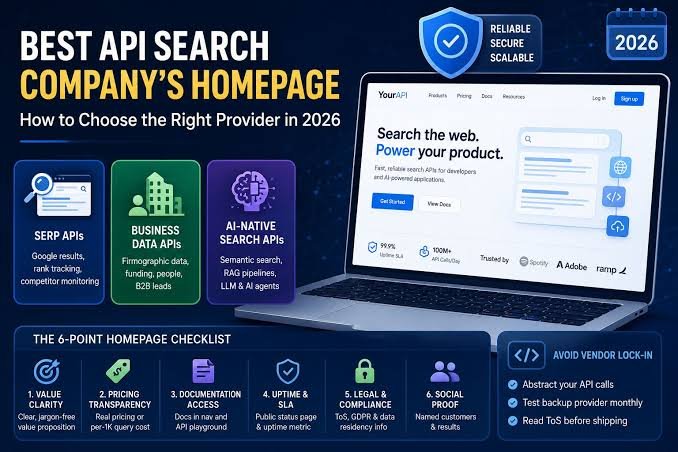
“Search API” gets used as an umbrella term for at least three quite different services, and mixing them up wastes real time, and honestly, real money too. So let’s split them apart properly first.
Type One: SERP APIs (Search Engine Results Page)
These send a query off to an actual search engine, Google, Bing, Brave, whatever, and hand you back the results as clean, structured JSON instead of a webpage you’d normally scroll through with your eyes.
Who actually uses these? SEO teams tracking keyword rankings, marketers watching competitor ad campaigns, researchers pulling trend data at scale. Basically, anyone who needs “what does Google show for this search” but automated, not manually typed in a hundred times a day.
The big names here are SerpApi, DataForSEO, Serper, Bright Data, and Scrapingdog. SerpApi’s often described as the veteran of the space, mature, well-documented, handles proxies and captchas so you don’t have to think about them. DataForSEO leans more into bulk, high-volume rank tracking, particularly handy if you’re running millions of daily checks rather than a handful.
Worth knowing, though: these providers technically scrape search engines rather than partnering officially with them. That’s created real friction. Google’s actually taken legal action against SerpApi over exactly this kind of scraping, which tells you something about how legally murky this category genuinely is.
Type Two: Hosted Site Search APIs
Completely different beast, honestly, despite sharing the same “search API” label.
Instead of querying an external search engine, these let you feed in your own content, product catalogue, documentation, blog posts, whatever, and the API powers a proper search bar on your own website or app.
Product teams, ecommerce companies, and SaaS products with big content libraries lean on this category constantly. Algolia’s probably the best-known name here, genuinely fast, polished, developer-friendly. Typesense and Meilisearch are increasingly popular open-source-friendly alternatives. Elasticsearch remains the heavyweight, industrial-strength option many larger companies build on. And Pinecone’s carved out its own lane specifically for vector and AI-native search, which matters more every year.
If your actual problem is “my website’s internal search box is rubbish,” this is the category you actually want, not a SERP API. I’ve seen people mix these up more than once, honestly, and it always ends in a slightly awkward realisation a few weeks into a project.
Type Three: AI-Native Search APIs
The newest, fastest-growing category, and honestly the one generating the most buzz right now.
These are purpose-built to feed AI agents and RAG (retrieval-augmented generation) pipelines. Rather than returning a title, link, and short snippet like a traditional SERP API, they use semantic understanding to find genuinely relevant content, and often return full page content directly, formatted specifically for an AI model to digest, not for a human scanning a results page.
Exa, Tavily, and Firecrawl sit right at the centre of this category. Exa’s built up real traction here, apparently used by companies like Cursor, Databricks, and Notion for research and context retrieval within their own products. Brave Search API and Perplexity’s Sonar also show up frequently in this bucket, alongside newer entrants like Olostep.
One genuinely important thing happened in this space worth flagging: Microsoft shut down its Bing Search APIs back in August 2025, pushing developers toward Azure’s newer “Grounding with Bing Search” setup instead. It’s a good reminder, honestly, that platform dependency is a real risk in this industry. Building your whole product on someone else’s API means you’re exposed if they change direction.
So, Which Type Do You Actually Need?
Genuinely depends on the actual problem you’re solving, and I think this is the bit most comparison articles gloss over too quickly.
Building an AI agent or chatbot that needs to “read” live web content? You want an AI-native search API, Exa, Tavily, or Firecrawl are the obvious starting points.
Need to track keyword rankings or monitor competitor SEO performance? SerpApi or DataForSEO fit that job specifically.
Building a proper search experience for your own website, app, or product catalogue? Algolia, Typesense, or Meilisearch are where you’d actually want to look, not a SERP API at all.
What Actually Matters When Comparing Providers
A few practical things worth weighing, honestly, beyond just the feature list on a homepage.
Pricing at real volume. Free tiers look great in a demo. Costs can escalate fast once you’re running production-level traffic, worth modelling that out before committing.
Data provenance and platform risk. Given what happened with Bing, and the legal pressure some SERP providers face, it’s worth asking how stable a provider’s underlying access actually is.
Documentation and developer experience. Honestly, this matters more day-to-day than people expect. A well-documented API with good SDKs saves genuinely significant engineering time.
Final Thoughts
“Best search API company” isn’t really a single, answerable question, not without first knowing which of the three categories you actually need. Confuse them, and you’ll end up evaluating the wrong shortlist entirely, wasted time nobody really has spare.
Once you’ve nailed down the actual job, tracking search results, powering your own site search, or feeding an AI agent, the right shortlist gets a lot shorter, and honestly, a lot easier to compare properly.
Useful links:
About The Author


