
What Does “Ion” Mean in Text? The Real Answer (Not What You Think)
ion meaning in text
What Does “Ion” Mean in Text? The Real Answer (Not What You Think)
Got a text that just said “ion” and stared at it like it was a typo? Yeah. Been there. My first thought, genuinely, was “iron,” minus the R, like someone’s autocorrect had a stroke halfway through the word.
Nope. Not iron. Not a typo either. Let’s actually sort this one out.
The Short Answer
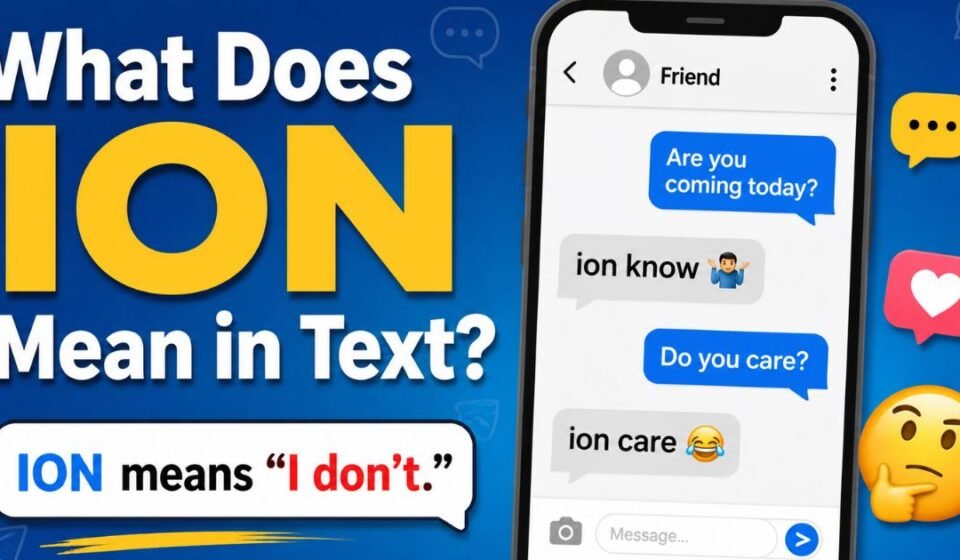
“Ion” means “I don’t.”
That’s it. That’s the whole trick. No hidden layers, no complicated backstory needed to just use it correctly. Someone texts “ion know,” and they mean “I don’t know.” Simple as that.
But, and there’s always a but with internet slang, understanding why it means that, and where it actually came from, makes it way easier to use naturally instead of just copying it awkwardly.
Where Does “Ion” Actually Come From?
Here’s the bit a lot of quick definitions skip over, and honestly, it’s the most important part.
“Ion” comes from African American Vernacular English, AAVE for short. Say “I don’t” out loud, fast, casually, the way you’d actually say it mid-conversation rather than reading it off a page. It kind of collapses into something that sounds like “ion,” doesn’t it? Try it. I did, felt a bit silly, but it works.
That phonetic pattern existed in spoken English long before it ever showed up as text. What happened is people started typing words the way they actually sound when spoken, rather than sticking to formal spelling. Dictionary.com traces this specific slang usage back through Black cultural expression online, and it’s worth genuinely crediting that origin rather than treating it like some vague, unattributed “internet slang” that appeared from nowhere.
It picked up serious traction through platforms like Twitter, particularly what’s often called Black Twitter, before spreading more broadly into TikTok, Instagram, and eventually just… everywhere. Regular texting between friends, group chats, comment sections. The usual path most internet slang takes these days.
How Do You Actually Use It?
Pretty simple, honestly, once you get the pattern.
“Ion” slots in right where “I don’t” would normally go. Drop it at the start of a sentence, and build the rest normally from there.
- “Ion know” → I don’t know
- “Ion care” → I don’t care
- “Ion feel like it” → I don’t feel like it
- “Ion watch reality TV” → I don’t watch reality TV
- “Ion think he’s coming” → I don’t think he’s coming
See the pattern? It’s a one-to-one swap, basically. Nothing fancy layered on top. You could genuinely just find-and-replace “I don’t” with “ion” in your head and land in the right place almost every time.
Wait, Doesn’t “Ion” Mean Something Else Too?
Good catch, actually, because yes, sort of.
You’ll occasionally see “ion” used as shorthand for “in other news,” typically used to abruptly shift a conversation to something completely different. It’s a bit less common than the “I don’t” meaning, honestly, and I’d say most people encountering “ion” in a casual text thread are dealing with the “I don’t” version roughly nine times out of ten.
Context sorts this out fast, though. If someone writes “ion, guess who I saw today,” that’s clearly the topic-shift version. If someone writes “ion know what you mean,” that’s obviously “I don’t know.”
And then, of course, there’s the actual scientific meaning, completely unrelated to either slang usage. In chemistry, an ion is an atom or molecule carrying an electrical charge, positive or negative, depending on whether it’s gained or lost electrons. Michael Faraday get credit for identifying ions all the way back in 1834, if you’re curious about the history there. Wildly different context, obviously, and nobody’s going to confuse a chemistry textbook with a text message. Context really does all the heavy lifting here.
Is It Rude to Use?
Not inherently, no. I think this is where a lot of people, especially anyone slightly older or less online, get tripped up.
“Ion” is casual. Relaxed. It’s the texting equivalent of a shrug, honestly. On its own, it’s not rude or dismissive. But tone matters, same as with basically any slang.
“Ion care what they think” can read as chill and unbothered. Same phrase, different context, could land as a bit cold or dismissive, particularly in a more serious or emotionally loaded conversation. I’d say: read the room the same way you would with any casual phrase. Slang doesn’t remove the need for social awareness, it just changes the vocabulary you’re applying it to.
When Should You Avoid Using It?
A few situations where I’d genuinely steer clear, honestly, no exceptions really:
- Professional emails. Obvious one, but worth saying anyway.
- Academic writing. Essays, reports, anything formal.
- Messages to people who clearly won’t understand it. Texting your gran “ion know” is just going to create confusion, not efficiency.
- Serious or sensitive conversations. Slang, generally, can undercut a message that needs to land with weight and sincerity.
Basically: same rules that apply to any casual internet slang. Save it for friends, casual chats, and situations where a relaxed tone actually fits what you’re saying.
Final Thoughts
“Ion” isn’t complicated once you know it. Just “I don’t,” spelled the way it actually sounds when spoken quickly and casually. It came out of AAVE, spread through social media, and now shows up pretty much everywhere digital conversation happens.
Next time someone texts you “ion,” you won’t be squinting at your screen wondering if autocorrect broke something. You’ll just know. And honestly, that’s most of what learning internet slang actually is, closing that one small confusing gap so the conversation keeps moving without a pause.
About The Author


